Rail runner · Player guide
DNRunner: read the next obstacle before following the cash
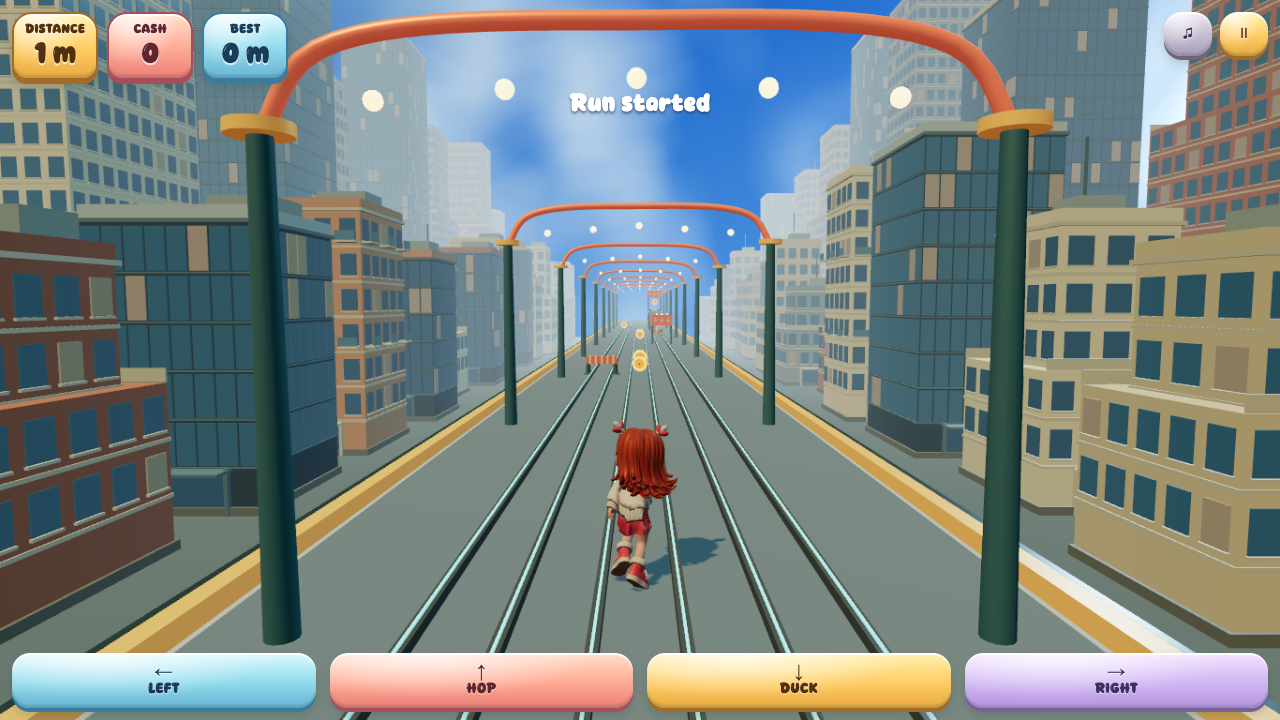
DNRunner is an endless run through a city rail district. Cash points toward possible routes, but the obstacle in that route determines whether you need to switch track, jump or duck.
Guide checked against the published game and project records on October 13, 2026.
How to play
- Start a run and read the route ahead of Rosie rather than looking only at her feet.
- Hop low barriers, duck overhead signs and switch tracks to avoid a blocked route.
- Collect cash when the approach and the landing are safe. Compare the finished run with your local personal best.
Controls
- Touch
- Swipe left or right to switch tracks, up to hop, or down to duck. The on-screen movement buttons provide the same actions.
- Keyboard
- Use left and right arrows to change track, up to hop and down to duck. A/D, W/S and Space also provide movement shortcuts.
A jump solves one obstacle, not the whole route
When cash sits beyond a low barrier, hopping can reach it. Before jumping, look at the space after the barrier: an overhead sign farther ahead may require ducking after you land.
A train is a long solid obstacle. Passing its cab does not make the carriage safe to cross through. The sloping front can lead to rooftop cash, but the rooftop also has hazards. Check the route beyond a pickup before committing to it.
Three decisions to practice
Make one deliberate lane change
Switching repeatedly at the last moment makes the next hazard harder to read. Choose a lane early enough to see what follows.
Distinguish height from direction
A low barrier calls for a hop; an overhead panel calls for a duck. Moving sideways is another choice when the neighboring route is open.
Keep the run alive before chasing a record
Distance, cash and rooftop pickups reward different decisions. Pick a goal for the run rather than trying to maximize every pickup on an unsafe route.
Progress and practical notes
Personal bests and preferences are kept locally. The run pauses when the page is hidden, and music is optional. Credits in the game identify Rosie’s model and the original Sunrise Line soundtrack.
Behind the project: design and implementation notes
Why the carriage matters
The city uses a common forward-travel reference so tracks, nearby buildings and obstacles read as part of one route. Trains have a complete carriage footprint; the collision rule does not disappear as soon as the front passes the runner.
Timing a continuous run
Lane movement and jumping are animated, but the host uses the returned pose for collisions and pickups. Reading what comes after an action remains important because forward travel continues between decisions.