Route puzzle · Player guide
DNConnectDot: connect the pairs and cover the whole board
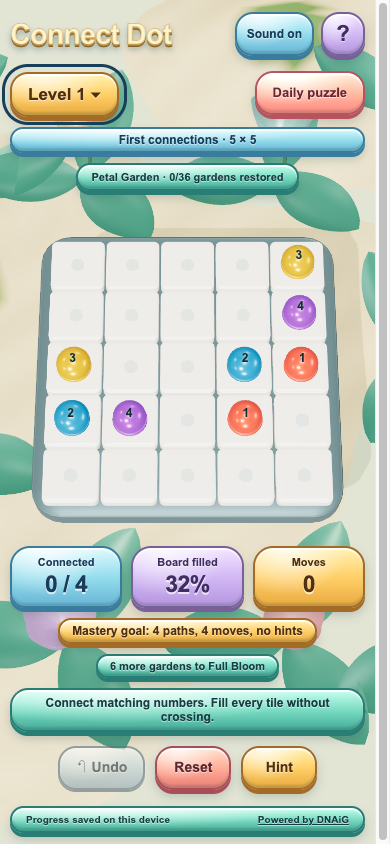
A connected pair is only part of a DNConnectDot solution. Every pair must connect, routes must stay separate, and no cell can remain empty. A tempting shortcut can leave the board impossible to finish.
Guide checked against the published game and project records on October 13, 2026.
How to play
- Find a pair whose route is constrained by a corner or narrow passage.
- Draw its route, then inspect the empty regions it leaves behind.
- Connect every pair and fill every cell. Revise any path that cuts off access to unused space.
Controls
- Mouse or touch
- Drag from a numbered endpoint to its matching endpoint. Drag backward to shorten a route.
- Keyboard
- Tab to the board. Use arrows to move, Space or Enter to start or release a path, and Escape to cancel.
Why the shortest route can fail
In this illustrative four-by-four board, the two 1 endpoints are next to each other on the left; the two 2 endpoints are next to each other on the right. Connecting each pair directly uses only four cells and leaves twelve empty.
A complete solution sends pair 1 around the upper two rows and pair 2 around the lower two rows. Each route uses eight cells. The endpoints are close together, but their successful routes are long enough to cover the board.
An explanatory board, not a campaign level. Arrows show the routes between the numbered endpoints.
Three decisions to practice
Protect access to corners
Before closing a route, check whether another pair can still reach every empty corner. A sealed pocket is a reason to revise the route even when its endpoints already connect.
Use a hint to study the remaining space
A hint reveals a route and removes conflicting paths. Examine the corridors it leaves for the other pairs, then continue from that smaller problem.
Separate finishing from mastery
Completing a level and improving its hint or move record are different goals. Solve the coverage problem first; replay when you want a cleaner route sequence.
Progress and practical notes
Campaign progress and the daily board have separate local records. Daily puzzles follow the local calendar date. A different browser profile has its own save; the game does not synchronize progress through a player account.
Behind the project: design and implementation notes
Coverage is the central constraint
A short connection may look correct while leaving an isolated pocket of empty cells. The player therefore needs to think about the shape of the unused board, not just the distance between matching dots. Narrow corridors and corners are useful starting points because fewer routes can reach them.
Try connecting a pair that has only one plausible passage, then examine the remaining empty space. If a route seals off a corner, shorten it and approach that pair from a different direction. A nearly finished board can be less useful than a partial board that preserves access to every region.
Making revision part of play
Drag between matching colored, numbered dots to draw a route. Drag backward to erase part of it, or pick up an existing route to continue or shorten it. Undo and reset support experimentation. A hint reveals one route and removes paths that conflict with it.
Numbers identify pairs independently of color. Keyboard input uses Tab to reach the board, arrows to move, Space or Enter to start or release a path, and Escape to cancel. These alternatives let the puzzle communicate its state without relying on one input device or on color alone.
A known solution, not a uniqueness claim
The project generates a walk through the board and divides that walk into paths. This supplies a known full-coverage solution before the puzzle is presented. It is an important distinction: a generated board should not ask a player to solve an impossible arrangement.
The construction does not certify that there is exactly one solution, nor does it prove a particular human difficulty. Larger boards add space to reason about, but the location of endpoints also affects the challenge. The campaign offers a level picker, while the daily board is based on the local calendar date.
Progress and presentation
Completed levels remain marked. Mastery distinguishes restoration, solving without hints and solving without hints in one move per color. Replaying can improve a level’s record; it does not repeatedly award the same completion. Daily progress is separate from the campaign record.
The game uses a garden setting and animated route feedback while keeping the grid and completion rules in the host. Saved progress is local to the browser. If storage is unavailable, play can continue in memory, but that session cannot promise persistence after closing the page.